Why Household-Centered CRM Matters
The single most important question to ask any CRM vendor: what is your parent record?
Contacts are the wrong unit for insurance
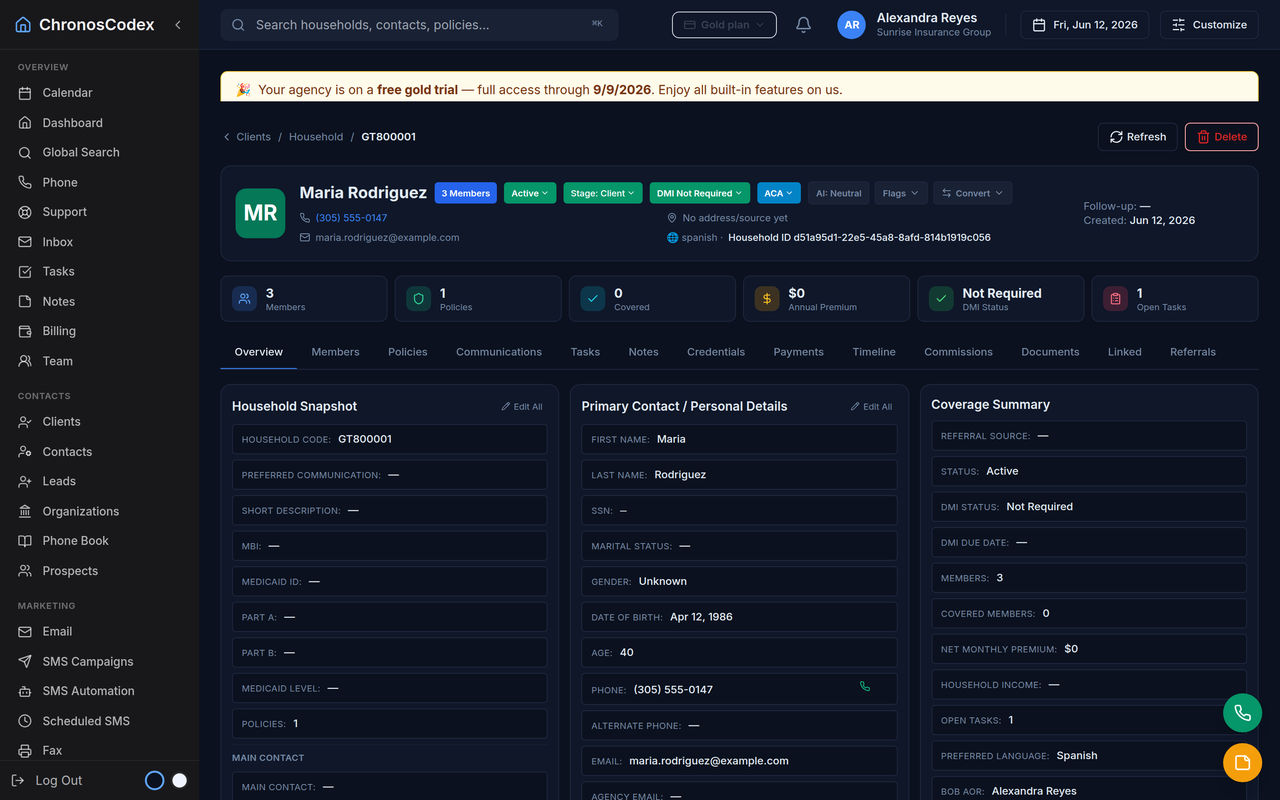
Insurance is bought by households. One enrollment can cover a primary applicant, a spouse, and dependents — each with their own date of birth, immigration documents, Medicare or Medicaid IDs, and coverage status. When your CRM's basic unit is the individual contact, the household exists only in your head, and every renewal season you reassemble it by memory.
What a household-centered model gives you
- One timeline: every call, text, email, note, and document for the family in one place.
- Policy clarity: policies attach to the household, with members listed on each policy — so "who is covered on what" is a glance, not an investigation.
- Cleaner renewals: a renewal touches the household once, not five contact records separately.
- Honest reporting: your book is measured in households and policies — the units carriers and commissions actually use.
Questions to ask any vendor
- Is the household a first-class record, or a workaround built from custom objects?
- Can a policy list which members it covers?
- When a client texts you, does the message land on the household timeline automatically?
- Can I see renewals by month across the whole book?
ChronosCodex answers yes to all four because it was extracted from a live agency managing hundreds of thousands of household records — the data model came first, the product second.
Want the CRM built for this workflow? ChronosCodex is a household-centered CRM for insurance agents and agencies — leads, policies, SMS, email, calls, commissions, and automation in one system. Visit ChronosCodex or start your workspace.
Transparent limits matter: Chronos includes generous plan limits so agencies can organize real books of business before upgrading.